
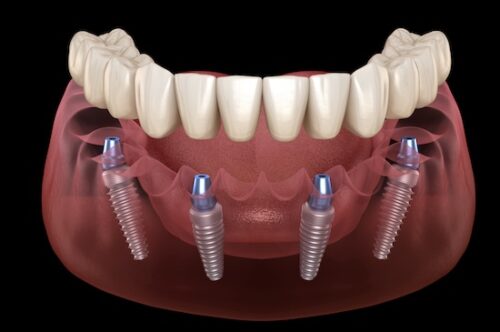
When several teeth are missing, implant options can start to blur together. You may hear about single implants, implant bridges, and All-on-4 during the same conversation, even though those treatments are not all trying to solve the same problem.
Traditional dental implants are often used to replace one tooth or a smaller group of missing teeth. All-on-4 is used when a full upper or lower arch needs to be replaced with one connected bridge supported by four implants.
Which option makes sense depends on what is going on with your mouth now. You may have one or two gaps with healthy teeth around them. Or you may be dealing with loose teeth, old crowns that keep failing, repeated infections, or a denture that has become harder to live with. The amount of bone in the jaw and the way your teeth fit together can affect the plan too.
At Fielder Park Dental in Arlington, TX, the team can look at the teeth, gums, bone, bite, and existing dental work before discussing implant options. That helps separate a smaller missing-tooth issue from a situation where an entire arch may need a different approach.
Traditional Dental Implants Usually Focus on One Area
A traditional dental implant is often used when one tooth is missing. The implant is placed in the jawbone where the tooth root used to be. After the area heals, a crown is attached to replace the visible part of the tooth.
This can be useful when the teeth beside the gap are healthy. Instead of placing a bridge that involves those neighboring teeth, the implant fills the space on its own. That may be especially helpful for a missing molar, since back teeth take a lot of chewing pressure every day.
Traditional implants can also replace more than one tooth. For example, two implants may support a bridge that replaces several teeth in one area. In other cases, someone may have implants in separate parts of the mouth because the missing teeth are not all side by side.
So, traditional implant treatment does not always mean one implant for every missing tooth. Sometimes it does. Other times, implants are used where support is needed while healthy teeth remain in place.
This route often works well when the trouble is limited to one part of the mouth. A tooth may have been missing for years, leaving you to chew around the space. Food may keep catching there. Or maybe a bridge failed, but the teeth around it still have a good outlook.
All-on-4 Is Used for a Full Arch of Teeth
All-on-4 is generally considered when most or all teeth in the upper jaw, lower jaw, or both need to be replaced. Instead of placing an implant beneath every missing tooth, four implants are placed across the arch to support one full bridge of replacement teeth.
This option often comes up when the problem has spread beyond one or two teeth. Several teeth may be loose because of gum disease. Maybe old crowns and bridges have been repaired repeatedly, and there is not much healthy tooth structure left underneath. For others, a denture moves during meals, lifts while talking, and has become part of nearly every decision around food.
At that point, it may be time to ask whether more repairs are still the best route. Natural teeth are worth keeping when they are healthy enough to last. However, when several teeth are loose, infected, heavily restored, or breaking down in the same arch, a full-arch option may be worth discussing.
All-on-4 is not a small treatment decision. Still, it can give someone a way to replace the teeth together instead of repairing one area while another one starts failing.
How The Restoration Is Different
The name All-on-4 tells you one part of the story: four implants support one full arch of teeth.
With a traditional implant, the final restoration may be a single crown or a smaller bridge. It fills a specific gap while the rest of the natural teeth remain in place. This can make sense when the rest of the mouth is generally healthy and the problem is limited to one area.
With All-on-4, the four implants support one connected bridge that replaces an upper or lower arch. The replacement teeth are not individual crowns placed one at a time. They are designed to work together as one full set.
That setup can help when there are not enough strong teeth left to build around. However, if someone still has several stable teeth with a good outlook, replacing only the teeth that are missing may be the more practical route. It is not about choosing the bigger treatment because it sounds more complete, but about how much of the arch is actually healthy and usable.
Bone Support Can Affect What Is Possible
Dental implants need enough bone for support. When a tooth has been missing for a long time, the bone in that area can gradually shrink because there is no longer a tooth root in place.
With traditional implants, there may not be enough bone exactly where an implant needs to go. In that case, a bone graft may be recommended before implant placement. A graft can help rebuild support in that area, although it may add another step and more healing time.
All-on-4 uses available bone differently. The implants are spread across the arch, and the ones toward the back are often placed at an angle. Because of that, some people who do not have enough bone in one specific area for a traditional implant may still have enough support for a full-arch plan.
A 3D scan helps show where the bone is strongest, where it has changed, and whether grafting is needed. It can also show issues that are not obvious by looking at the mouth alone, which is why implant planning usually involves more than a quick exam.
The Treatment Timelines Are Not the Same
Traditional implant treatment often happens in stages. The implant is placed first, then the area heals before the final crown or bridge is attached. Depending on the tooth, bone support, gum health, and whether grafting is needed, that process can take several months.
All-on-4 also involves planning, surgery, healing, and a final bridge. However, the process is built around replacing an entire arch rather than one small area.
In many cases, remaining teeth are removed and implants are placed during the same appointment. Depending on the treatment plan and how secure the implants are that day, patients may leave with a temporary set of teeth while the implants and gums heal.
Later, after the gums and bone have had time to settle, the final bridge is made. That gives the dental team time to check the bite, make adjustments, and create the final restoration around how the mouth has healed. So, same-day teeth may be part of the process, but there are still follow-up visits and another stage after surgery.
When Repairs Start Adding Up
Most people will need some dental work over the years. A filling may wear out. A crown may eventually need replacement. One tooth may need a root canal after a deep cavity or crack.
The picture changes when several teeth in one arch are all becoming problems at once. You may have one tooth that needs a crown, another that is cracked, a bridge that is failing, and teeth with old root canals that are starting to act up again. When that keeps happening, it can be hard to know whether another repair is a good investment or just another short-term fix.
That is one reason people start asking about All-on-4. It can be a way to stop making separate repairs on teeth that are all heading in the same direction.
It is not automatically the answer. Some teeth can still be treated successfully and kept for years. However, when the overall pattern is repeated breakdown across the same arch, it is reasonable to step back and compare the long-term options instead of only fixing the tooth that hurts today.
Traditional Implants Can Be a Better Fit When Healthy Teeth Remain
Traditional implants are often a better fit when healthy natural teeth are still present and the problem is limited to a specific area.
For example, if one molar is missing but the teeth next to it are healthy, a single implant can replace that tooth without changing the neighboring teeth. If two or three teeth are missing together, an implant-supported bridge may restore that section while leaving the rest of the mouth alone.
This approach can preserve more of what is already working. Still, the remaining teeth need an honest evaluation. A tooth may still be present, but it may also have deep decay, severe bone loss, large old fillings, or cracks that make its future less predictable.
That is why an implant consultation involves more than counting gaps. The dental team also has to consider which teeth are still reliable, which ones may need more treatment soon, and how the bite may hold up once implants are added.
Daily Life Can Change in Different Ways
Both All-on-4 and traditional implants are designed to improve function. Still, the day-to-day change depends on what you are dealing with before treatment.
A single implant may help you chew on one side again without food packing into the gap. It can also help keep nearby teeth from slowly leaning into that space.
An implant-supported bridge can restore a wider section of teeth, which may make chewing feel more balanced. That can be useful for someone who has been favoring one side because the other side is missing teeth.
All-on-4 is often discussed with people who are tired of working around a loose denture. In that situation, the change may be more about eating without worrying about movement, talking without feeling the denture shift, and not having to think about adhesive throughout the day.
Implant-supported teeth still need regular care. The gums around the implants, the bite, and the bridge itself all need to be checked over time.
Cleaning Is Part of the Long-Term Plan
Traditional implants are brushed much like natural teeth. However, if there is a bridge, you may need floss threaders, small interdental brushes, or a water flosser to clean underneath it properly.
All-on-4 bridges need cleaning underneath the replacement teeth as well. Food and plaque can collect along the gumline and under the bridge, so patients are often shown how to use special floss, small brushes, water flossers, or a combination of tools.
The routine may feel unfamiliar at first. However, once you understand where food tends to collect and which tools work best, it becomes easier to keep up with.
Regular dental visits are still important. Implants cannot get cavities, but the gums and bone around them can still become inflamed or infected. Those visits allow the team to check the tissues, the fit of the bridge or crown, and the way the bite is wearing over time.
Cost Depends on How Much Treatment Is Needed
Traditional implants and All-on-4 are very different levels of treatment, so the costs are different too.
A single implant is generally less expensive than rebuilding an entire arch because it involves one implant and one crown. However, when several teeth need replacement, the cost of multiple implants, crowns, bridges, and related treatment can add up.
All-on-4 is a larger investment because it may involve extractions, surgery, several implants, a temporary set of teeth, a final bridge, imaging, and follow-up care. The estimate can look very different depending on the condition of the teeth and whether other treatment is needed first.
When comparing options, it helps to ask what is included in the full estimate. For example, ask whether the temporary and final teeth are included, whether extractions are part of the cost, and what follow-up care may be needed later.
Traditional implants may be the more practical option when only a few teeth need replacement. In other cases, All-on-4 may make more financial sense than years of crowns, root canals, bridges, extractions, and repair work across the same arch.
Choosing Between All-on-4 and Traditional Implants in Arlington, TX
All-on-4 and traditional dental implants both replace missing teeth, but they are used in different ways. Traditional implants are often a good fit when a few teeth are missing and the remaining teeth are healthy enough to keep. All-on-4 is often considered when most teeth in an upper or lower arch are missing, loose, badly damaged, or no longer likely to last.
At Fielder Park Dental in Arlington, TX, the team can evaluate your gums, bone support, bite, and existing dental work before explaining what may be possible. Call to schedule a consultation if you are missing teeth, struggling with a denture, or trying to decide whether ongoing repairs are still the best use of your time and money.
FAQs
Is All-on-4 the same as getting four regular dental implants? Not exactly. All-on-4 uses four implants to support a full arch of replacement teeth. Traditional implants may replace one tooth at a time or support a smaller bridge in one area.
Can All-on-4 replace upper and lower teeth? Yes. All-on-4 can be used for the upper arch, lower arch, or both, depending on the condition of the teeth, gums, and bone.
Do I need a bone graft for All-on-4? Not always. The angled placement of some implants may reduce the need for grafting in certain cases. However, a scan and exam are needed to see whether there is enough bone support.
Can I get temporary teeth the same day as All-on-4 surgery? Depending on the treatment plan and how secure the implants are, some patients may leave with a temporary set of teeth on the day of surgery. The final bridge is usually made later after healing and follow-up visits.
How long do traditional dental implants take? The timeline varies based on bone support, whether grafting is needed, gum health, and how the area heals before the final crown or bridge is placed.
Can you eat normally with All-on-4 implants? Many people can eat a wider range of foods with an implant-supported full arch than with loose dentures. However, there is a healing period, and the dental team will give you food guidelines for each stage.
How do you clean under an All-on-4 bridge? Patients often use special floss, interdental brushes, a water flosser, or a combination of tools to clean under the bridge and along the gums.